
Patient identifiers
How Awell uses FHIR-style system and value pairs so one patient can carry several identifiers from several systems without losing which is which.
A patient is a real person documented across many systems, and each system assigns its own identifier to track them. Medical record numbers, provider numbers, national registry numbers: many are issued by external bodies, including government agencies.
Because record-keeping is distributed, one patient accumulates many identifiers. Reconciling them is a large part of health data management, and getting it wrong means treating one person as two.
Awell identifiers are FHIR system and value pairs
Awell adopted FHIR identifiers. Fast Healthcare Interoperability Resources anticipates exactly this problem by letting a patient hold multiple identifiers, sometimes called business identifiers.
Each identifier is a system and value pair:
- The system says which namespace the identifier belongs to, such as a particular hospital's medical record number (MRN) scheme.
- The value is the identifier within that namespace.
Only the pair is unambiguous: 12345 on its own means nothing, but 12345 in the context of one
hospital's MRN system identifies one person.
What this means for an integration
Set up identifier systems before sending any identifiers. They're configured under Settings → Identifier systems, and several common ones are preconfigured, so a national registry number or an EHR's own patient ID can be picked from a list rather than defined by hand.
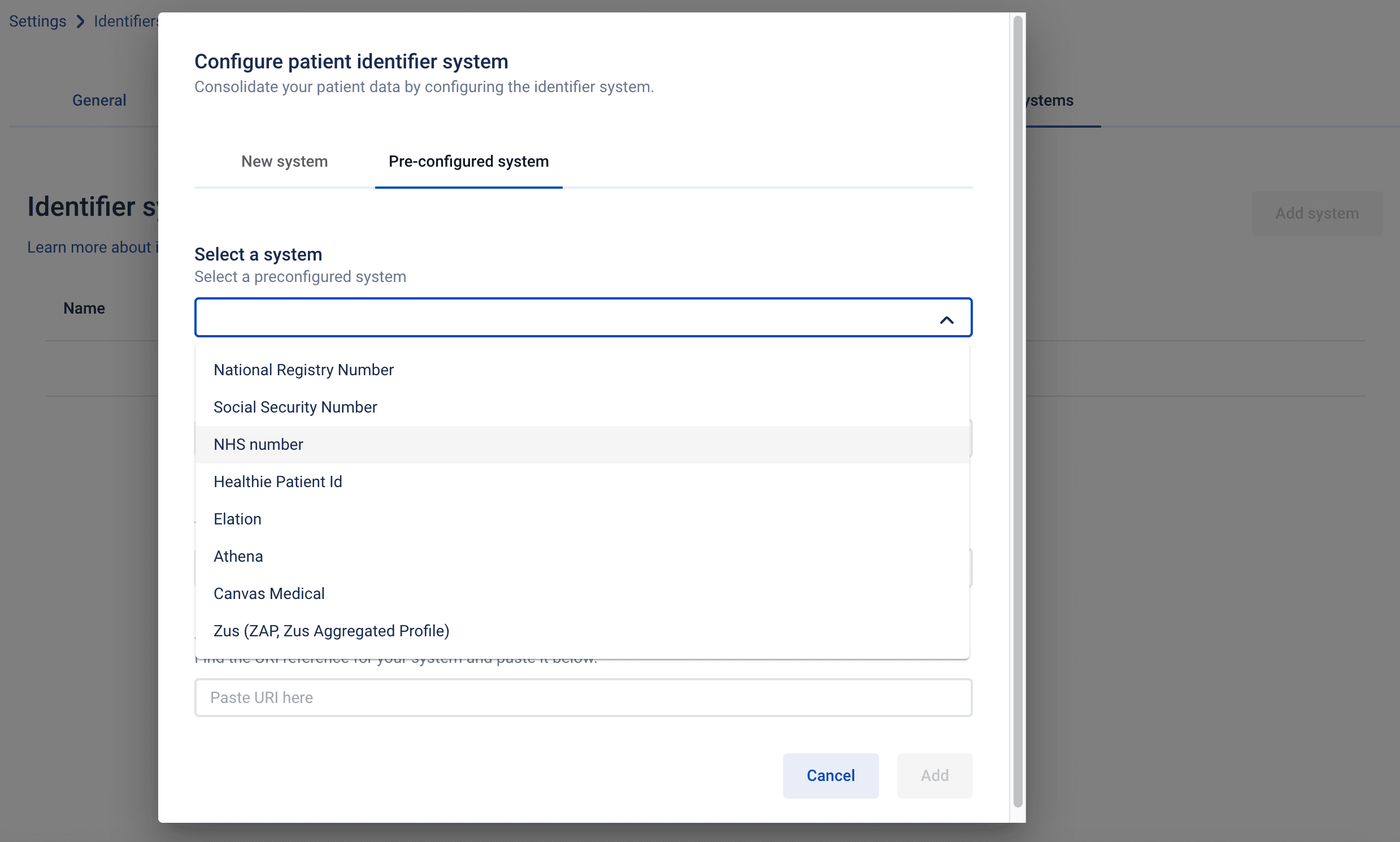
Identifier systems are configured per environment, and the name and system must match across Sandbox and Production or lookups fail. See the go-live checklist.
A care flow can be started by identifier rather than by Awell patient ID, so the calling system never has to store an Awell ID. See Care flows in the API reference.
Looking a patient up by identifier is also how an integration avoids creating duplicates.
Next steps
Next: Patient Demographics Query, which searches on an identifier.
EMR integration terminology
The vocabulary used in Awell's EMR integrations, from HL7 and Mirth to ADT, SIU and ORU messages, with what each is used for.
Patient creation with SIU messages
Drive care flows from hospital appointment messages, so scheduling an appointment starts a care flow and canceling it stops one.