
Get started
What Awell is, the handful of concepts everything else builds on, and where to go next as a care flow author or as an engineer connecting systems to them.
Organizations adopt Awell to change something specific about how care happens, and to be able to show that it changed: cost per episode, patients seen without adding staff, a quality measure that has to improve this year.
Awell coordinates what happens to a patient over time: which form goes out when, who reviews it, and what happens if nobody responds.
Awell is built for a methodology called CareOps
The practice behind the product is called CareOps, and it has a public community and a lifecycle. It does for care delivery what DevOps did for software, by bringing clinical experts, clinical operations, engineering, product and compliance into one loop instead of handing documents between them.
The loop repeats rather than running once:
- Design & Validate. Work out what should happen, and check it with the people who will do it.
- Build & Operate. Put it into software that patients and care teams actually use.
- Monitor & Prove. Watch what happens, and show which changes improved results.
- Rinse, Repeat. Feed the evidence back into the design.
A care process can stop after the second stage, or never leave a document at all. The platform is built for closing that loop: shortening the time between deciding a process should change and patients experiencing the new version.
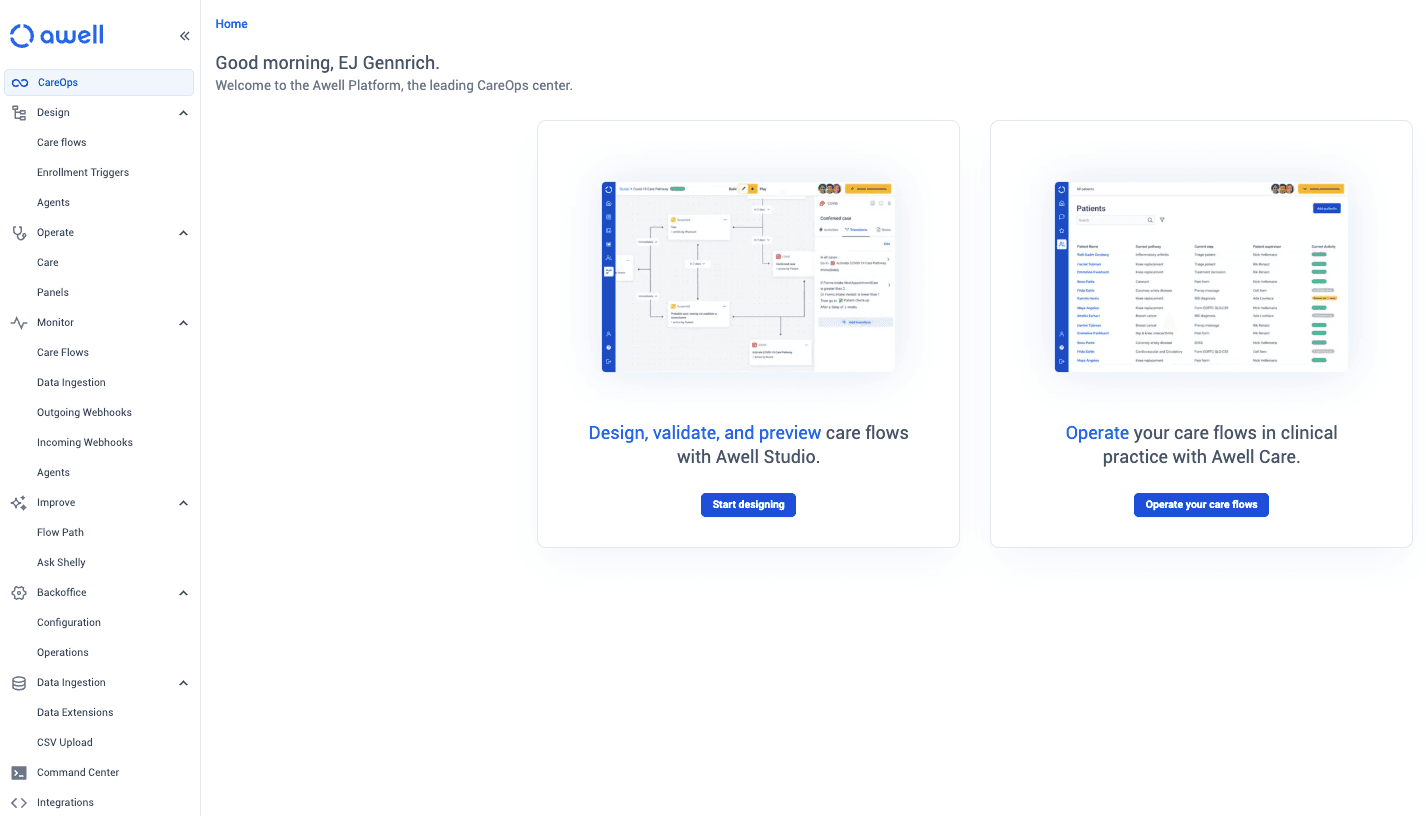
The navigation follows the same loop. Design is where care flows are built, Operate is where they are delivered, Monitor is where they are watched, and Improve is where the evidence comes back.
What teams use it to change
- Capacity. Intake once collected by phone is collected by the care flow, so the same team takes on more patients without adding people.
- Speed of change. The operations team adjusts a care flow itself, rather than raising a ticket and waiting for an engineering cycle.
- Quality and compliance. Every eligible patient gets the reminder, the appointment, and the follow-up, so a reporting requirement is met without anyone chasing it by hand.
Deciding which of those to aim at, and how to measure it, is covered in Decide what to improve, which is worth reading before building rather than after.
Read the pages in order
This section explains the ideas the rest of the docs assume, then points to the right path.
Concepts to read first
- What is a care flow? The central idea: a plan of activities that runs itself.
- Awell platform overview. Studio, Care, Panels, and the Orchestration API, and which one each role works in.
- Key terms. The words these docs use precisely, so every page means the same thing by them.
After that, the path depends on the role
Care flow authors decide what should happen, for whom, and when, in clinical and operational terms. Continue to Design care flows.
Engineers wire care flows to electronic health records, APIs, and data warehouses, so every activity has real data behind it. Continue to Connect systems or Automate with events.
The two paths cross constantly: pages aimed mainly at engineers say so, and pages that need an engineer's help say where to hand off.